
CONTEMPORARY | BOOTH C14
Elnara Nasirli
DIGITAL | BOOTH X15
Morehshin Allahyari
ART DUBAI CONTEMPORARY
Gazelli Art House is pleased to present a selection of new and recent works by contemporary artists Elnara Nasirli and Morehshin Allahyari across both the Contemporary and Digital sections this April.
Elnara Nasirli presents a series of works exploring myth, material memory, and speculative futures, examining how landscapes endure, or are reconstructed after disappearance. The booth will showcase an immersive installation inspired by ancient epics in which forests act as thresholds to the spirit world, displayed alongside a sculpture of ceramic amber and intricately engraved cement wall works. Nasirli reimagines a vanished wilderness through sound, textile, and sculptural form in Ruhlar of the Forest (2026). Trees silenced by extinction are reanimated through spectral audio, while stitched paintings conjure fragmented canopies and undergrowth. Cast concrete and copper stones evoke permanence while revealing their artificial construction.
Phytoharmonic Archive (2026) unfolds in warm amber tones as a sculptural installation of biomorphic ceramic forms. Each form houses embedded flash drives containing what may be the final acoustic data of disappearing plant species. Recorded through bioelectrical sensors that translate vegetal impulses into sound, these fragile recordings function as the last living traces of plant memory preserved in digital form. The cement slab works draw inspiration from Ips typographus (Linnaeus, 1758), the bark beetle, whose movement leaves delicate, engraved traces in the wood it inhabits. Nasirli’s works form an ecosystem where myth and material intersect, inviting reflection on what is lost, what persists, and what we leave behind. The artist currently has an installation from her series Whispering Forest on view at Diriyah Art Futures until 16 May in Saudi Arabia.
-
 Whispering ForestVendor:Whispering ForestElnara Nasirli
- Regular price
-
$50,000.00 - Regular price
-
- Sale price
-
$50,000.00

ART DUBAI DIGITAL
Morehshin Allahyari presents Sirr al-Asrār (Secret of Secrets) (2026), a new body of work shown alongside two velvet prints and a video installation from the Moon-Faced series (2021–2023).
سراالسرار (Secret of Secrets) forms part of Allahyari’s current research into medieval Islamic manuscripts and scientific devices, engaging alchemy within the Islamicate world as both a scientific and philosophical practice. Central to the work is distillation, a process invented by Muslim scientists and understood not only as a chemical process but as the purification and elevation of essence and soul. In alchemical traditions, secrecy (سر) functions as a protective technology: in books and manuscripts, knowledge is encoded through symbols, allegory, poetic fragments, and temporal delay to guard its transformative power from extraction or misuse. In this work, Allahyari invites reflection on what these sacred and speculative practices of transformation and protection might offer today, in moments of crisis and collective uncertainty.
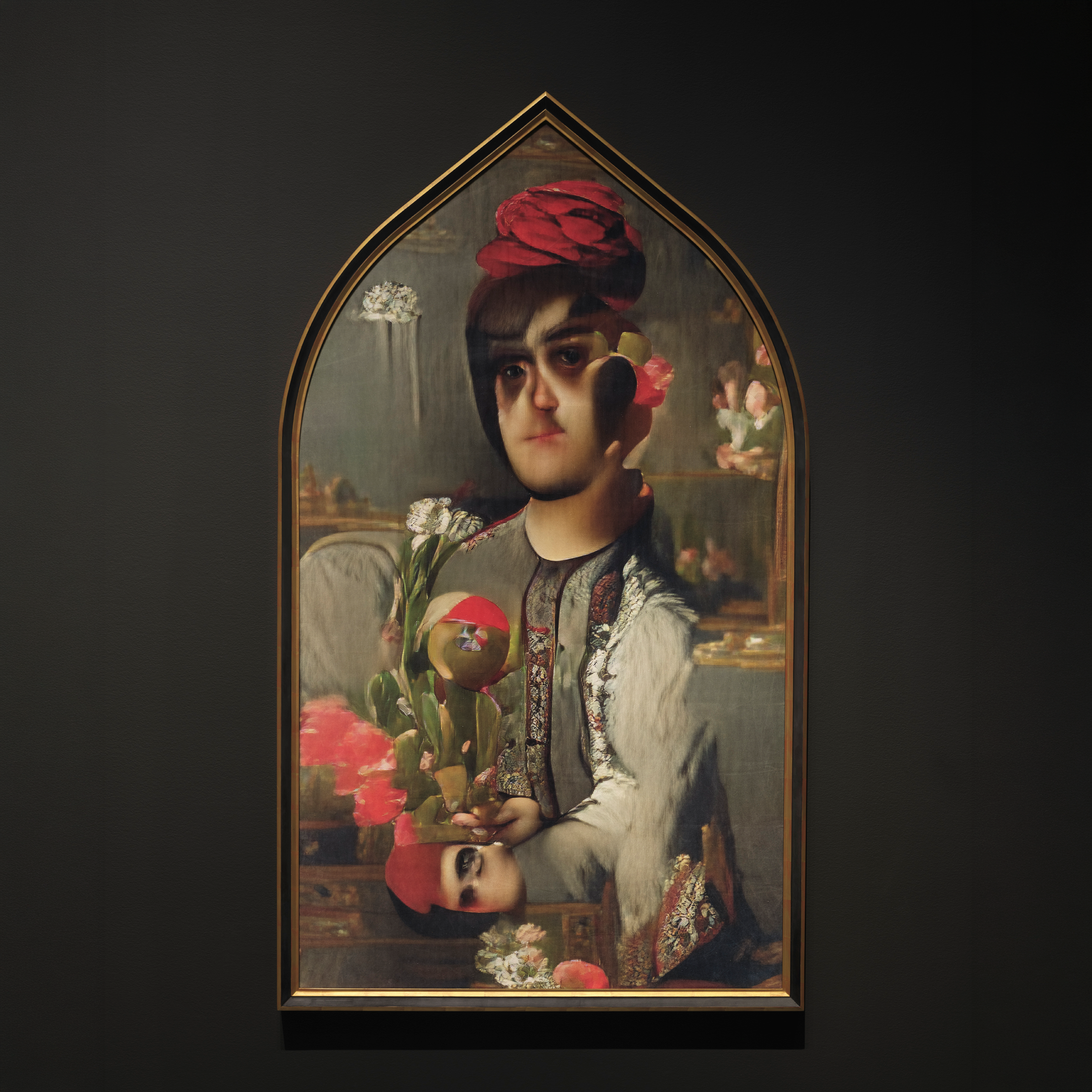
The Moon-Faced series draws on ماه طلعت, a term in ancient Persian literature once used as a genderless descriptor of beauty, later narrowed in contemporary Iran. Allahyari traces a parallel shift in Qajar Dynasty portraiture (1786–1925), where modernisation, European realist painting, and photography played a role in erasing gender-fluid visual traditions. Using a multimodal AI model trained on the Qajar painting archive through carefully selected keywords, Allahyari generates new moving-image portraits that reclaim nonbinary presence within Persian visual culture. The video work features an original score by Mani Nilchiani.
Together, Allahyari’s works weave history, technology, and imagination, reanimating erased traditions while exploring the alchemical potentials of secrecy, transformation, and care.
Also on view, Memo Akten and Katie Hofstadter’s Superradiance Meditations (2026) is a new work in the ongoing Superradiance project, presented as a video and sound-based work, combining poetry, movement, neuroscience, and generative AI to explore embodiment and humanity’s entanglement with a living planet.
-

 Moon-Faced Velvet Fragments IIVendor:Moon-Faced Velvet Fragments IIMorehshin Allahyari
- Regular price
-
$25,000.00 - Regular price
-
- Sale price
-
$25,000.00
-

 Moon-faced Velvet Fragments IVendor:Moon-faced Velvet Fragments IMorehshin Allahyari
- Regular price
-
$25,000.00 - Regular price
-
- Sale price
-
$25,000.00


About the Artists
Nouf Aljowaysir (B. 1993; Riyadh, Saudi Arabia)
Nouf Aljowaysir is an award-winning new media artist based in Brooklyn. She splits her time between the art and tech world to study how technologies are designed and their consequential impacts on society and culture. Focussing on our changing relationship with algorithms, she poses intimate questions to tools of “intelligence”, using the exchange to reflect not only on herself but also on how these systems shape our ways of seeing and thinking. Nouf has been awarded residencies at ThoughtWorks Arts and Somerset House. Her work has been exhibited internationally at galleries and festivals such as the Centre Pompidou, Paris, France; M+ Museum, Hong Kong, China; and the Tribeca Film Festival, New York, US. among others. Her film Ana Min Wein? (Where Am I From?) won the 2023 Lumen Prize for Moving Image and was released by The New York Times Op- Docs series in June 2024. Her work was recently on display in the exhibitions, The World Through AI, at Jeu de Paume, Paris, France (11 April — 21 September 2025), and Lehnert & Landrock: Revisiting a Colonial Archive at Photo Elysée, Lausanne, Switzerland, (31 October 2025 — 1 February 2026).
Elnara Nasirli (B. 1987; Baku, Azerbaijan)
Elnara Nasirli is an artist rooted in environmental technology, drawing inspiration from the intersection of biotechnology and mixed media. Her work transcends conventional boundaries, weaving together painting, sculpture, collage, and installation to construct boundless realms. Guided by the Greek concepts of ‘bios’ (life) and ‘morphe’ (form), Nasirli’s visual language evokes the essence of organic shapes and forms. The installations she creates beckon viewers into immersive audio-visual odysseys, inviting reflection on diverse facets of the human experience, self-expression, and the natural world. Nasirli’s kinetic sculpture Desert Air Oasis: BreathCore 7 (2025) was presented at Burning Man 2025, Black Rock Desert, Nevada. Her major project Whispering Forest (2023–ongoing) is currently on view at Diriyah Art Futures, Saudi Arabia, in the exhibition Of the Earth: Earthly Technologies to Computational Biologies. Nasirli was the winner of Lavazza Blend Forward Award and Audience Award at BBA Berlin, 2025. Recent solo exhibitions include No Man’s Sky: Braiding Sweetgrass, MoMA Tbilisi, Georgia (2023), Fluxus Frequency Collective, Gazelli Art House, Baku (2023) and Radix: Radical Root Explorations, QGallery Berlin (2023). Group shows include MAMA, Bahrain National Museum Art Center, Manama (2025), Arte Laguna Prize Finalist Exhibition, Venice (2024), Parallel Worlds, Gazelli Art House Baku (2024), Monument to Freedom, YARAT Contemporary Art Center, Baku (2024), Jawhar, Jossa, Alserkal Avenue, Dubai (2023).
Morehshin Allahyari (B. 1985; Tehran, Iran)
Morehshin Allahyari (Persian: یرایهللا نیش هروم ), is a Bay Area-based Iranian-Kurdish artist and an assistant professor of Digital Media Art at Stanford University. She uses 3D simulation, video, code, sculpture, and digital fabrication as tools to re-figure myth and history. Through archival practices and storytelling, her work weaves together complex counternarratives in opposition to the lasting influence of Western technological colonialism in the context of SWANA (South West Asia and North Africa). Morehshin has been part of numerous exhibitions, festivals, and workshops around the world including Venice Biennale di Architettura, New Museum, The Whitney Museum of American Art, Pompidou Center, MoMA, Victoria and Albert Museum, Queens Museum, and Museum of Modern Art, Taipei. She has been featured in Art21, The New York Times, BBC, Huffington Post, Wired, National Public Radio, Parkett Art Magazine, and Al Jazeera, among others. Morehshin’s work has been the subject of critical analysis across books, academic articles, and dissertation chapters of over 100 publications. She is the recipient of the Gold Art Prize (2025), Creative Capital Award (2025), The University of California, Berkeley Chancellor’s Postdoctoral Fellowship Award (2024), The United States Artist Fellowship (2021), The Joan Mitchell Foundation Painters & Sculptors Grant (2019), The Sundance Institute New Frontier International Fellowship (2019), and the Leading Global Thinkers of 2016 award by Foreign Policy magazine.
Memo Akten (B. 1975; Istanbul, Turkey)
Memo Akten is a multi-disciplinary artist and computer scientist creating Speculative Simulations and Data Dramatisations investigating the intricacies of human-machine entanglements; perception; consciousness; Cosmosapience; and the harmonies and tensions between technology & ecology, science & spirituality, modernity & ritual, self & collective intelligence. For more than a decade, he’s been working with Artificial Intelligence, Big Data and our Collective Consciousness as scraped by the Internet, to reflect on the human condition. Drawing connections between intelligence in machines, intelligence in nature, computer science, fundamental physics, biology, neuroscience and philosophy, his work is ultimately driven by a profound curiosity in the nature of reality, nature of life, and nature of the mind. He creates algorithmic and data-driven moving images, sounds, and large-scale responsive installations and performances. He holds a PhD from Goldsmiths University of London in Artificial Intelligence, and he is Assistant Professor at University of California San Diego. Akten has received numerous awards, including the prestigious Prix Ars Electronica Golden Nica (2013). His work has been widely exhibited and performed internationally at venues such as the Venice Biennale, Venice, Italy. Alongside his artistic partner, Katie Peyton Hofstadter, Memo Akten is the GAZELL.iO digital resident for September 2025. The latest in their Superradience series, Chapter 3: Cosmosapience, and Chapter 4: Superposition / The Reckoning, are currently in development.
Katie Peyton Hofstadter (B. 1981; Georgia, US)
Katie Hofstadter is a multidisciplinary artist, writer, and curator whose work investigates the complex relationships between embodiment, consciousness, and technologically mediated imagination. Through her diverse practice, she explores the dynamics between knowing and feeling, and investigates how emerging technologies, including artificial intelligence, shape both cultural narratives and direct experience. She has exhibited internationally and co-founded several international art campaigns, including the ARORA network, bringing together over 70 artists creating new AR monuments to diverse female and gender-expansive voices in public spaces; and the Climate Clock NYC, a monument to planetary time and global call to #actintime on the climate crisis. Her art and public projects have been covered by major media outlets, including the New York Times and Los Angeles Times. Her essays and interviews appear in leading publications including Flash Art, The Believer, BOMB, and The Bulletin of Atomic Scientists.